
Lithium Battery Repairing Course – Master Lithium Battery Testing, Repair & Maintenance
Contact us
Start Your Training Journey
Fill the form and get a call back within 24 hours. Our Counsellor will answer all your questions!
Call now: +91 8851511577
Lithium batteries are becoming increasingly important in modern electronics, electric vehicles, solar energy storage systems, power backup solutions, and portable devices. As the demand for lithium battery technology continues to grow, skilled technicians who understand battery testing, troubleshooting, maintenance, and repair can develop valuable technical skills and explore new career opportunities. Our Lithium Battery Repairing Course is designed to help students understand lithium battery technology, identify battery faults, test individual cells, troubleshoot Battery Management Systems (BMS), and learn the fundamentals of battery pack servicing.
We offer practical-oriented training covering lithium-ion and lithium iron phosphate (LiFePO4) battery technologies. Different lithium battery chemistries have different voltage characteristics, charging requirements, safety considerations, and applications. Our course introduces students to these differences and explains how lithium battery packs operate. You learn about individual cells, battery configurations, voltage and capacity testing, BMS functions, charging and discharging systems, protection circuits, and common battery faults.
Whether you want to start a battery repair business, work with an electronics service centre, enter the electric vehicle industry, or expand your existing electronics repair skills, this training can help you build a foundation in lithium battery technology. The course focuses on understanding real-world battery systems, systematic fault diagnosis, correct testing procedures, and safe working practices. Training activities should be performed under appropriate supervision using suitable equipment and safety precautions.
As lithium batteries are increasingly used in electric mobility, solar energy storage, inverters, UPS systems, and portable electronics, knowledge of battery testing and maintenance can be useful across several technical fields. By learning lithium battery fundamentals and diagnostic techniques, you can prepare for further specialization in battery servicing, battery pack maintenance, and energy storage technologies
Our Lithium Battery Repairing Courses
Lithium-Ion Battery Repairing Course
Lithium-ion batteries are widely used in laptops, power tools, portable electronics, electric vehicles, and energy storage systems. These batteries offer high energy density but require careful monitoring, correct charging, and suitable protection systems. Our lithium-ion battery training introduces you to cell construction, battery pack configurations, voltage testing, capacity evaluation, BMS operation, and common battery-related problems. You learn how to approach battery diagnosis systematically and understand the difference between a cell fault, a connection problem, a protection-system fault, and a charger-related issue.
LiFePO4 Battery Testing and Repair Training
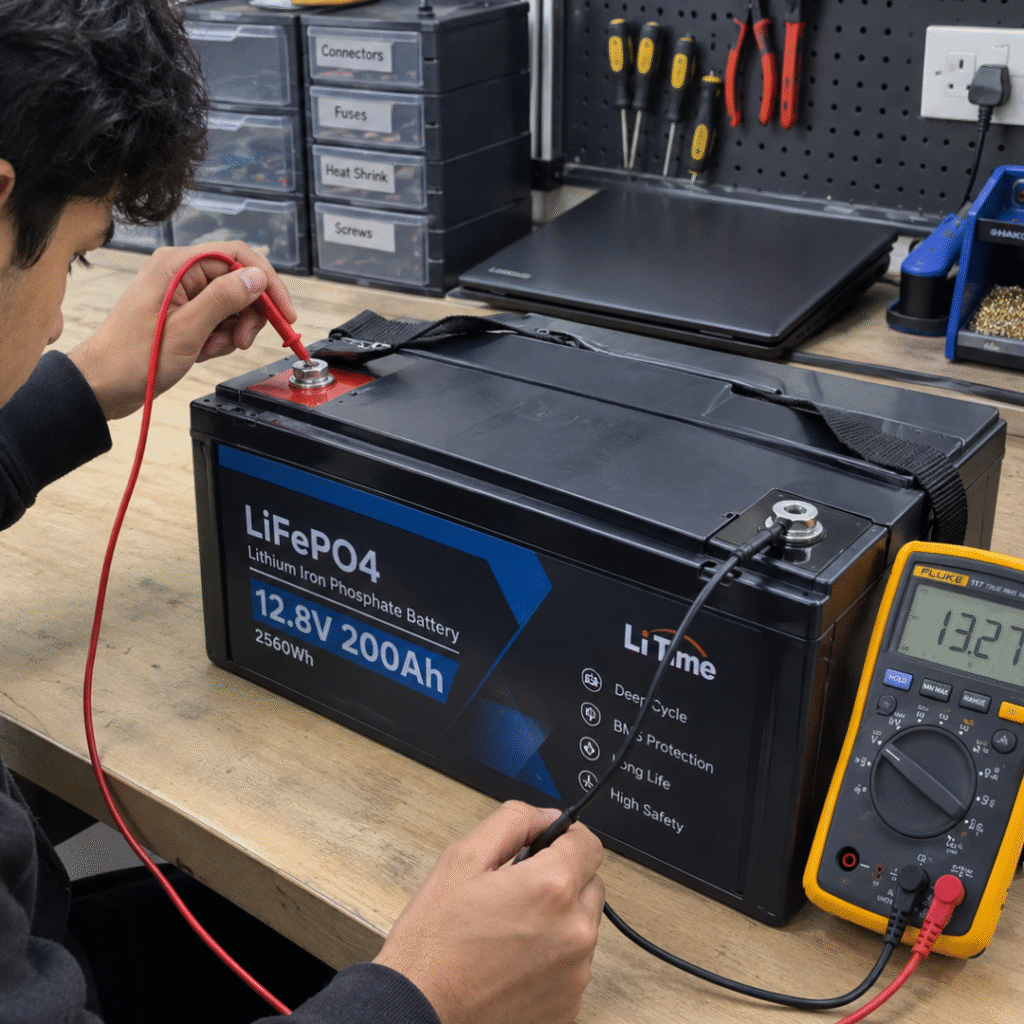
Lithium iron phosphate (LiFePO4) batteries are commonly used in solar energy storage, backup power systems, and other applications requiring durable rechargeable battery solutions. This training section introduces LiFePO4 cell characteristics, battery pack configurations, voltage limits, charging requirements, BMS protection, and battery performance evaluation. You learn the fundamentals of identifying abnormal readings, understanding cell imbalance, and diagnosing common battery pack issues.
Who Should Join This Course
Electronics technicians wanting to specialize in lithium battery technology
Electrical technicians expanding their technical skills
Inverter and UPS repair technicians
Solar installation and maintenance professionals
Electric vehicle service technicians
Laptop, mobile, and power-tool repair technicians
Students after 10th or 12th interested in technical careers
Individuals interested in starting a battery testing or servicing business
Existing battery technicians wanting to strengthen their diagnostic knowledge
What You Will Learn
Lithium Battery Technology Fundamentals: Understand how lithium batteries store and release electrical energy. Learn the basic construction of lithium-ion cells, including the anode, cathode, separator, electrolyte, and current collectors. Study the differences between common lithium battery chemistries, including lithium-ion and LiFePO4. Understand nominal voltage, capacity measured in ampere-hours (Ah), energy measured in watt-hours (Wh), charge and discharge rates, and the factors that influence battery performance.
Battery Cell Types and Identification: Learn about cylindrical, prismatic, and pouch lithium battery cells. Understand how their physical construction, specifications, and applications differ. Learn to read cell labels and datasheets, identify nominal voltage and capacity ratings, and understand the importance of matching cell specifications to the intended battery pack. Study the differences between individual cells, modules, and complete battery packs.
Battery Voltage and Capacity Testing: Learn the fundamentals of checking battery voltage and interpreting test readings. Understand the difference between open-circuit voltage, loaded voltage, and usable battery capacity. Explore suitable testing equipment and controlled charge-discharge testing concepts. Learn how to recognize abnormal voltage readings and understand why voltage alone cannot establish the complete health or remaining capacity of a battery.
Battery Management System (BMS): Understand the role of a Battery Management System in monitoring and protecting lithium battery packs. Study cell-voltage monitoring, current monitoring, temperature monitoring, overcharge protection, over-discharge protection, overcurrent protection, and short-circuit protection. Learn about cell balancing, protection cutoffs, fault indicators, and the importance of using a compatible BMS for the battery chemistry and pack configuration.
Lithium Battery Pack Configuration: Learn the fundamentals of series and parallel battery connections. Understand how series connections affect pack voltage and how parallel connections affect capacity and current capability. Study the relationship between cell ratings, pack voltage, total capacity, and energy. Learn why compatible cells, appropriate interconnections, suitable insulation, and properly rated protection systems are essential when designing or evaluating a battery pack.
Battery Charging and Discharging Systems: Understand lithium battery charging principles and the importance of using chargers designed for the specific battery chemistry and configuration. Study charging stages, charging voltage, current limits, discharge limits, and temperature considerations. Learn about common charging problems, including batteries that do not accept a charge, chargers that stop unexpectedly, and protection systems that interrupt charging. Explore how to distinguish charger-related problems from possible battery or BMS faults.
Battery Internal Resistance and Health Evaluation: Learn how internal resistance can affect voltage drop, heat generation, and battery performance under load. Understand how appropriate testing equipment can help compare cell performance and identify potential weak cells. Study the difference between voltage imbalance, reduced capacity, increased internal resistance, and other signs of battery degradation. Learn why reliable battery health assessment requires suitable testing methods rather than relying on a single measurement.
Cell Balancing and Voltage Imbalance: Understand why individual cells in a battery pack may develop different voltage levels over time. Learn the basic principles of passive and active cell balancing and the role of balancing circuits in battery management. Study how imbalance can affect usable capacity and trigger protective cutoffs. Learn how to interpret imbalance-related symptoms and identify when a pack requires professional inspection or further testing.
Common Lithium Battery Problems: Study common battery complaints, such as a battery not charging, unexpectedly shutting down, delivering reduced backup time, showing abnormal voltage readings, or triggering a BMS protection event. Learn a systematic diagnostic approach that considers the charger, connectors, wiring, cell condition, temperature sensors, and protection electronics. Understand the difference between symptoms and confirmed faults, and why damaged or unsafe battery packs require appropriate isolation and assessment.
Battery Pack Connections and Electrical Components: Learn about the purpose of battery terminals, connectors, busbars, fuses, wiring, insulation, temperature sensors, and protective components. Understand the importance of correct component ratings, secure connections, and resistance to unwanted heating. Study common connection-related problems and the principles of inspecting battery packs for visible damage, corrosion, loose connections, or signs of overheating.
Battery Testing Equipment and Diagnostic Tools: Understand the applications and limitations of digital multimeters, battery analysers, capacity testers, electronic loads, thermal monitoring equipment, and suitable BMS diagnostic tools. Learn how to select appropriate equipment for a particular battery system and interpret measurements correctly. Understand why testing lithium batteries requires equipment with suitable voltage, current, and power ratings.
Solar, Inverter and Energy Storage Batteries: Explore how lithium battery packs are used in solar energy storage, inverter backup systems, UPS applications, and other stationary energy storage systems. Learn about battery voltage compatibility, charging control, inverter communication, BMS integration, and system protection. Understand the importance of matching the battery, charger, inverter, and protection equipment to their specified operating requirements.
Electric Vehicle Battery Fundamentals: Understand the role of lithium battery packs in electric scooters, motorcycles, cars, and other electric mobility applications. Learn about battery modules, pack voltage, capacity, BMS monitoring, temperature management, and electrical protection. Explore common battery performance concerns and the diagnostic considerations involved in electric vehicle battery servicing. High-voltage traction batteries require specialized training, equipment, and safety procedures.
Battery Safety and Handling Procedures: Learn the essential safety principles involved in handling lithium battery cells and packs. Understand the risks associated with short circuits, excessive charging or discharging, mechanical damage, overheating, and thermal runaway. Study safe work areas, appropriate personal protective equipment, insulated tools, terminal protection, and procedures for dealing with damaged batteries. Understand why swollen, leaking, punctured, overheated, or otherwise compromised batteries must not be treated as ordinary repair jobs.
Battery Maintenance and Performance Monitoring: Learn the factors that influence battery lifespan, including temperature, charging conditions, discharge depth, storage conditions, and operating load. Understand how battery monitoring data can help identify changes in performance over time. Study appropriate maintenance practices, inspection records, and basic methods of evaluating whether a battery remains suitable for its intended application.
Career Opportunities After Course
Lithium battery testing technician
Battery pack inspection and maintenance technician
Battery service centre technician
Solar battery and energy storage service technician
Inverter and UPS battery technician
Electric mobility service technician
Battery quality testing assistant
Electronics repair technician specializing in battery systems
Battery servicing business owner, subject to appropriate training
What's Included
-
Lithium battery technology fundamentals
-
Lithium-ion and LiFePO4 battery concepts
-
Cell identification and specification reading
-
Battery voltage and capacity testing concepts
-
BMS operation and protection systems
-
Series and parallel battery configurations
-
Charging and discharging fundamentals
-
Cell balancing and battery health evaluation
-
Common battery fault diagnosis
Why Learn Lithium Battery With us?
Practical Oriented Technical Learning
Understanding lithium battery systems requires more than memorizing terminology. Students need to understand how cells, protection circuits, charging systems, and battery management electronics work together. A practical-oriented learning approach helps connect theoretical concepts with real-world diagnostic situations. Training activities can help students understand test readings, recognize abnormal conditions, and develop a systematic approach to battery troubleshooting.
Focus on Testing and Fault Diagnosis
Replacing a component without identifying the underlying problem can lead to repeated failures. Learning a structured diagnostic process helps technicians investigate possible causes before deciding on the next step. Our course content focuses on understanding battery symptoms, evaluating relevant measurements, and distinguishing between cell-related issues, BMS faults, charging problems, and connection-related faults.
Understanding Different Lithium Battery Technologies
Lithium batteries are not all the same. Different chemistries, cell formats, voltage ratings, and applications require different considerations. Learning the fundamentals of lithium-ion and LiFePO4 batteries helps students understand why battery specifications matter and why charging, protection, and replacement components must be compatible with the particular system.
Industry-Relevant Applications
Lithium battery technology is used in electric mobility, solar energy storage, backup power systems, portable electronics, and industrial equipment. Understanding these applications can help students identify areas in which they may wish to develop additional expertise. A solid technical foundation can support further learning in battery diagnostics, energy storage systems, and battery service operations.
Safety-Focused Training
Lithium batteries can store substantial amounts of energy and may create serious hazards if damaged, incorrectly charged, or improperly handled. Learning about electrical protection, safe testing practices, battery condition assessment, and appropriate handling procedures is essential for anyone entering this field. Training should emphasize recognizing unsafe conditions and knowing when a battery requires specialized professional intervention.
Guidance for Technical Career Development
Lithium battery knowledge can complement existing skills in electronics repair, electrical maintenance, inverter servicing, solar installations, and electric mobility. Students can use their foundational knowledge to explore suitable technical roles, pursue further specialization, or evaluate opportunities in battery testing and servicing.