
Electric Vehicle Repairing Course – Master EV Diagnostics, Repair & Maintenance
Call now: +91 8851511577
Electric vehicles are becoming increasingly popular in India due to advancements in battery technology, rising fuel costs, and the growing demand for sustainable transportation. Electric scooters, motorcycles, cars, and commercial vehicles rely on advanced electrical and electronic systems that require skilled technicians for servicing, troubleshooting, and maintenance. Our Electric Vehicle Repairing Course is designed to help students understand EV technology, identify common faults, learn diagnostic techniques, and develop a foundation in electric vehicle repair and maintenance.
We offer practical-oriented training covering the fundamental components and operating principles of electric vehicles. The course introduces students to electric motors, lithium battery packs, Battery Management Systems (BMS), motor controllers, charging systems, DC-DC converters, wiring harnesses, sensors, and electrical protection systems. Students learn how these components work together and how to approach common EV problems using systematic fault diagnosis.
Whether you want to start an electric vehicle repair business, work at an EV service centre, become an EV technician, or expand your existing electrical and electronics repair skills, this course can help you build a foundation in electric mobility technology. The training focuses on understanding EV components, interpreting diagnostic information, identifying possible faults, and following appropriate safety procedures.
As electric vehicles continue to expand across two-wheelers, three-wheelers, passenger cars, and commercial transportation, technical knowledge of EV systems can be useful in several service and maintenance fields. Learning the fundamentals of electric vehicle technology can help students explore opportunities in EV servicing, battery maintenance, motor diagnostics, charging systems, and electrical troubleshooting.
Our Electric Vehicle Repairing Courses
Electric Two-Wheeler Repairing Course
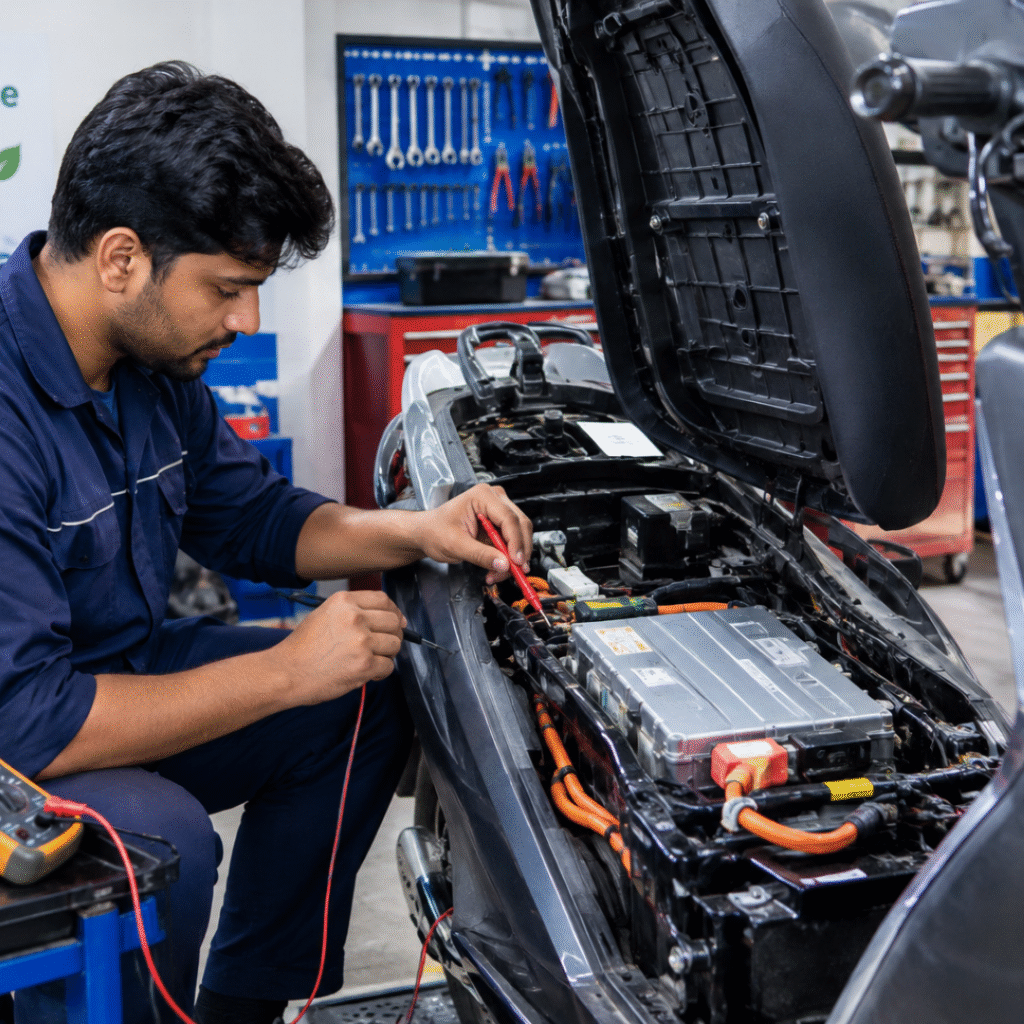
Electric scooters and motorcycles use battery packs, electric motors, motor controllers, throttles, sensors, wiring harnesses, and electronic protection systems. Our electric two-wheeler training introduces students to the main components of electric scooters and motorcycles, their operating principles, and common technical problems. Learn about battery-related faults, motor issues, controller problems, charging failures, wiring faults, and basic diagnostic procedures used in electric two-wheeler servicing.
Electric Vehicle Battery Testing and Repair Training
The battery pack is one of the most important components of an electric vehicle. This training section introduces lithium-ion battery technology, battery pack configurations, voltage testing, capacity evaluation, Battery Management Systems, cell balancing, and battery protection. Students learn how to understand battery performance problems, identify abnormal readings, and recognize possible battery or BMS faults. Battery repair activities must follow appropriate safety procedures and be performed with suitable equipment and supervision.
EV Motor and Controller Repairing Course
Electric motors and motor controllers work together to convert electrical energy into mechanical power. This section introduces students to common EV motor types, motor controller functions, throttle signals, sensor inputs, and basic control-system operation. Learn about common motor and controller symptoms, possible causes of performance problems, and diagnostic approaches for investigating electrical faults.
EV Charging System and Electrical Troubleshooting Training
Electric vehicles depend on compatible charging systems and properly functioning electrical connections. This training section introduces charging fundamentals, charging ports, wiring connections, charging-related protection systems, DC-DC converters, and auxiliary electrical circuits. Students learn about common charging problems, electrical supply issues, connector faults, and basic troubleshooting principles.
Who Should Join This Course
Students after 10th or 12th interested in technical careers
Electrical and electronics technicians
Automobile mechanics interested in electric vehicles
Electric scooter and motorcycle repair technicians
Battery testing and servicing technicians
Inverter and UPS repair technicians
Electronics repair professionals
Individuals interested in starting an EV repair business
Existing automobile service technicians wanting to learn EV technology
Individuals interested in electric mobility and vehicle diagnostics
What You Will Learn
Electric Vehicle Technology Fundamentals: Understand how electric vehicles operate and how they differ from conventional petrol and diesel vehicles. Learn about the basic components of an electric vehicle, including the battery pack, electric motor, motor controller, charging system, DC-DC converter, and vehicle control electronics. Understand how electrical energy is stored in the battery and converted into mechanical power to drive the vehicle.
Types of Electric Vehicles: Learn about different electric vehicle categories, including battery electric vehicles (BEVs), hybrid electric vehicles (HEVs), and plug-in hybrid electric vehicles (PHEVs). Understand the basic differences in their powertrains, battery systems, charging requirements, and applications. Explore the growing use of electric scooters, motorcycles, three-wheelers, passenger cars, and commercial electric vehicles.
Electric Vehicle Battery Technology: Understand the role of batteries in electric vehicles and learn the fundamentals of lithium-ion battery technology. Study battery cells, modules, pack configurations, voltage ratings, capacity, energy storage, and charging characteristics. Learn about common battery performance problems and the importance of using compatible charging and protection systems.
Battery Management System (BMS): Learn how a Battery Management System monitors and protects an EV battery pack. Understand cell-voltage monitoring, current measurement, temperature monitoring, overcharge protection, over-discharge protection, overcurrent protection, and cell balancing. Explore how BMS faults, communication issues, and protection events may affect vehicle operation and charging.
Electric Vehicle Motor Types and Operation: Learn about the basic operating principles of electric motors used in electric vehicles. Explore common motor technologies, including brushless DC (BLDC) motors, permanent magnet synchronous motors (PMSMs), and induction motors. Understand the relationship between the motor, controller, battery supply, speed, torque, and vehicle performance.
EV Motor Controller and Throttle System: Understand how the motor controller regulates power delivered to the electric motor. Learn about throttle signals, controller inputs, motor speed control, electrical connections, and protective functions. Study common symptoms such as a motor that does not start, irregular acceleration, reduced performance, and controller-related faults. Learn the fundamentals of systematic diagnosis and component testing.
EV Wiring Harness and Electrical Components: Learn about wiring harnesses, connectors, fuses, relays, switches, sensors, terminals, and electrical protection components used in electric vehicles. Understand the importance of correct wiring connections, component ratings, insulation, and electrical continuity. Study common electrical faults, including loose connections, damaged wires, blown fuses, corrosion, and interrupted power supply.
EV Charging Systems and Charging Problems: Understand the fundamentals of electric vehicle charging and the importance of using compatible chargers. Learn about charging ports, charging cables, charging voltage, current limits, charging indicators, and basic charging protection systems. Study common charging complaints, such as a vehicle that does not charge, charging that stops unexpectedly, and faults involving connectors or charging equipment.
DC-DC Converter and Auxiliary Power Systems: Understand how DC-DC converters supply power to low-voltage electrical systems in electric vehicles. Learn about their role in powering auxiliary electronics, lighting, control circuits, and other vehicle accessories. Study common symptoms of DC-DC converter problems, low-voltage battery issues, and auxiliary power failures.
EV Sensors and Control Systems: Learn about the role of sensors in electric vehicle operation. Understand how throttle sensors, temperature sensors, speed sensors, position sensors, and other monitoring components provide information to vehicle control systems. Explore how sensor faults and incorrect signals can affect acceleration, motor operation, battery monitoring, and vehicle performance.
Electric Vehicle Diagnostic Tools: Understand the purpose of digital multimeters, diagnostic scanners, battery analysers, insulation testing equipment, and other suitable diagnostic tools used in EV servicing. Learn how to interpret basic electrical measurements, check component specifications, and identify possible causes of common faults. Understand the importance of using correctly rated equipment and following manufacturer-recommended diagnostic procedures.
Common Electric Vehicle Problems: Study common EV problems, including vehicles that do not start, batteries that fail to charge, reduced driving range, unexpected shutdowns, poor acceleration, motor noise, controller faults, and electrical system failures. Learn a systematic diagnostic approach that considers battery condition, wiring, connectors, sensors, charging equipment, and control electronics. Understand why symptoms should be investigated before deciding which component requires repair or replacement.
Electric Vehicle Battery Performance and Maintenance: Learn about the factors that influence battery performance and service life, including temperature, charging conditions, discharge depth, storage conditions, and operating load. Understand the importance of monitoring battery condition, identifying unusual performance changes, and following suitable maintenance procedures. Explore the fundamentals of battery capacity evaluation and performance monitoring.
EV Regenerative Braking Fundamentals: Understand the basic principle of regenerative braking and how an electric motor can help recover energy during deceleration. Learn how regenerative braking interacts with the motor controller, battery pack, and vehicle control systems. Explore common operating considerations and the importance of system compatibility and proper functioning.
Electric Vehicle Safety and Handling Procedures: Learn essential safety principles for working with electric vehicle electrical systems. Understand the risks associated with high-voltage circuits, short circuits, battery damage, electrical shock, and thermal runaway. Study appropriate personal protective equipment, insulated tools, electrical isolation, and safe working procedures. Understand that high-voltage EV systems require specialized training, suitable equipment, and manufacturer-approved procedures before inspection or repair.
EV Maintenance and Preventive Servicing: Learn the fundamentals of electric vehicle maintenance, including visual inspections, connector checks, wiring inspection, battery performance monitoring, charging-system checks, and identifying unusual motor or controller behaviour. Understand the importance of maintenance records, systematic fault diagnosis, and following manufacturer-recommended service schedules.
Career Opportunities After Course
Electric vehicle repair technician
Electric two-wheeler service technician
EV battery testing technician
Battery pack maintenance technician
EV motor and controller diagnostic technician
Electric vehicle electrical technician
EV charging system service technician
Electric mobility service centre technician
EV quality testing assistant
What's Included
Electric vehicle technology fundamentals
Types of electric vehicles and their components
Lithium-ion battery technology concepts
Battery Management System operation
EV motor types and operating principles
Motor controller and throttle system fundamentals
EV wiring harness and electrical components
Charging system fundamentals
DC-DC converter and auxiliary power systems
Why Learn Electric Vehicle Repairing With Us?
Practical Oriented Technical Learning
Understanding electric vehicle technology requires knowledge of electrical systems, electronic components, batteries, motors, and control circuits. A practical-oriented learning approach helps students connect technical concepts with real-world service situations. Training activities can help students understand diagnostic readings, recognize common faults, and develop a systematic approach to EV troubleshooting.
Focus on Testing and Fault Diagnosis
Replacing components without identifying the underlying cause can lead to repeated failures and unnecessary expenses. Learning a structured diagnostic process helps technicians investigate possible causes before deciding on repairs. Our course content focuses on understanding symptoms, interpreting electrical measurements, and distinguishing between possible battery, motor, controller, charging, and wiring problems.
Understanding EV Batteries, Motors and Controllers
Electric vehicles depend on several interconnected systems. Battery packs supply electrical energy, motor controllers regulate power delivery, and electric motors generate mechanical movement. Understanding how these components work together helps students develop a stronger technical foundation for diagnosing vehicle performance issues and learning advanced EV servicing techniques.
Industry-Relevant Electric Vehicle Applications
Electric vehicle technology is used in scooters, motorcycles, three-wheelers, passenger cars, and commercial transportation. Understanding the components and operating principles of these vehicles can help students explore different technical specializations. A solid foundation in EV systems can support further learning in battery diagnostics, motor servicing, charging systems, and electric vehicle maintenance.
Safety-Focused Training
Electric vehicles contain electrical systems and battery packs that can present serious hazards if handled incorrectly. Learning about electrical isolation, battery protection, appropriate testing equipment, and safe handling procedures is essential for anyone entering this field. Training should emphasize recognizing unsafe conditions and understanding when specialized professional assistance is required.
Guidance for Technical Career Development
Electric vehicle knowledge can complement existing skills in automobile repair, electrical maintenance, electronics servicing, battery technology, and inverter repair. Students can use their foundational knowledge to explore technical employment opportunities, pursue advanced EV training, or evaluate opportunities in electric vehicle servicing and maintenance.